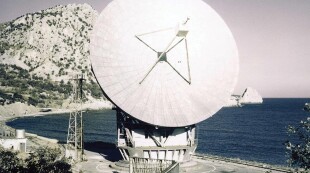
Evpatoria Pluton antenna at South Station, as seen in 2009.
Rumlin via Wikimedia Commons, CC BY-SA 3.0.
On November 19, 1962, engineers at the Evpatoria planetary radar in Crimea pointed their brand new instrument’s antenna at Venus and, on the same 769 MHz frequency they used for ordinary ranging, transmitted a single word in Morse code: “mir”—Russian for both “world” and “peace.” The pulse struck the Venusian atmosphere and bounced back, confirming the new instrument’s success. Five days later they sent two more words: “USSR” and “Lenin.”
In addition to bouncing back to Earth, these signals continued outward into interstellar space and are still in transit today. Although this test of a planetary radar is sometimes referred to as the first directed radio message to extraterrestrial intelligence, it was not, strictly speaking, an attempt at communication. But the three words in Morse code were also more than just errant signals, and, in a new article in the Journal for the History of Astronomy, historian Gabriela Rădulescu argues that the transmission belongs to the history of the search for extraterrestrial intelligence (SETI) as part and parcel of the Soviet Union’s tradition of sending messages into deep space.
This is contested ground. Whether Soviet SETI was meaningfully more transmission-minded than the American version is an argument that has never been settled, but Rădulescu’s reading of the early 1960s makes a good case that something in the Soviet context made attempts at communication feel less like a new beginning than the obvious next step from the sending of those first words. She does so by reading a single article in the original Russian, line by line, against the life of the man who wrote it, and from that basis draws a general argument about how the Soviets understood SETI.
Iosif Shklovsky’s foundational paper
The paper is Iosif Shklovsky’s “Is Communication with Intelligent Beings of Other Planets Possible?” in the July 1960 issue of Priroda, the Academy of Sciences’ flagship popular science journal. It is the first Soviet SETI publication and the direct predecessor of the 1962 book Universe, Life, Mind, which sold out its first print run of 50,000 copies within hours and reached Anglophone readers in an expanded 1966 edition co-authored by Carl Sagan. The book is famous, but the article, where the ideas were worked out, has never been deeply analyzed. What English-language scholarship knows of Soviet SETI has come mostly through translation and participants’ own recollections.
Shklovsky’s article was a response to a short paper published in Nature ten months earlier, generally credited as being the first scientific SETI paper. Its authors were Cornell physicists who came to the question sideways, Giuseppe Cocconi and Philip Morrison.
Cocconi was an Italian experimental cosmic-ray physicist who came to the US after World War II. Morrison, a theoretician, had spent the war on the Manhattan Project, went to Hiroshima to survey the atomic bomb’s aftermath, and came home an ardent opponent of the arms race. Neither was an astronomer, and their argument was disarmingly plain: radio telescopes already in operation were sensitive enough to detect a deliberate signal from a nearby star, if anyone were sending one. The hard part was guessing where in the spectrum to listen.
Their paper made the case for the 21-centimeter hydrogen line. Hydrogen is the most abundant element in the universe, and the 1420 MHz line it emits is a frequency any civilization capable of radio astronomy would already have found: a plausible meeting place. The paper’s effect was immediate. Within months, Otto Struve, the newly appointed founding director of the National Radio Astronomy Observatory, and his young colleague Frank Drake announced Project Ozma, which Drake ran from NRAO’s Green Bank site in 1960 as the first systematic search for an artificial signal.
Shklovsky likewise quickly read Cocconi and Morrison’s paper, in Russian translation, and was better placed than almost anyone to build on it. The frequency the two had settled on was, in some sense, his. In 1948 he calculated that the 21-centimeter line should be observable across the galaxy, three years before anyone detected it. He published his book Radio Astronomy in 1953, the year he taught the first Soviet course on the subject at Moscow’s Sternberg Astronomical Institute. His students summarized his career around two achievements: the hydrogen line and the evolution of matter in the universe. The Cornell proposal happened to need both.

I. S. Shklovsky in 1980.
NRAO/NSF/AUI.
An evolutionary universe and the search for connection
By every account Rădulescu assembles, Shklovsky was also an artist who ended up in astrophysics. He had wanted to be a painter and never trained formally, but his colleague Vyacheslav Slysh insisted that he “thought like an artist”—reasoning in images and indifferent to instruments, even ones he had helped design. He read voraciously outside his field and recited poetry from memory.
Rădulescu’s word for what he does in the 1960 article is that he “painted” the cosmos. Cocconi and Morrison had posed three questions that needed to be answered about possible extraterrestrial intelligence: how planets form, how life begins, and how societies develop. Attempting to answer all three, Shklovsky composed a picture of matter organizing itself from diffuse nebulae up through stars, planets, life, and finally intelligence, which was less of a fluke than an ordinary, even expected occurrence.
Considering the question of whether intelligence lasts, Shklovsky answered no: everything that comes into being dies, and thinking matter is no exception. He proposed a variable he called the “psychozoic era,” the span during which a world hosts thinking beings—similar to what Drake would represent as “L” in his eponymous equation the following year—and calculated that if it averaged a million years, there might be only one or two such worlds within a hundred light-years.
Rădulescu’s argument hinges on what she calls the naturalization of interstellar communication. Shklovsky’s titular question, “Is communication with intelligent beings of other planets possible?” assumes the beings and asks only about the possibility of connecting with them. The word svyaz in the title means “communication,” but also “contact” and “bond.” Framed as the next stage in the organization of matter, interstellar communication needed no more defense than radio astronomy itself.
According to Rădulescu, Shklovsky’s view became institutionalized within a few years with the establishment of a standing SETI section inside the Soviet Union’s Radio Astronomy Council. It was chaired by Vladimir Kotelnikov, who had authorized the Venus messages, and its proceedings treated transmission to probable correspondents in space as a legitimate aim. In this work, as historian of technology George Basalla has also argued, Soviet scientists consistently took a more active approach than their American contemporaries, who largely “listened.”
And this approach endured. Alexander Zaitsev, who ran the later Evpatoria transmissions and coined the term METI (messaging extraterrestrial intelligence), spent years insisting that sending and searching are two faces of one problem, and that reluctance to transmit is cultural rather than scientific. Rădulescu is careful to note that Shklovsky’s own views on active transmission went largely undocumented, but she argues that the approach was closely linked to his way of describing the universe, rather than a matter of happenstance or national temperament.
The acronym SETI, the search for extraterrestrial intelligence, dates to approximately 1976, and Soviet scientists only adopted it decades later. Using it to describe early Soviet work risks flattening out that work’s distinctive characteristics. Rădulescu’s article belongs to a small body of recent work by Ken Kellermann, Mark Sheridan, Lev Gindilis, Leonid Gurvits, and myself that is pulling the Soviet story into a literature on SETI that previously focused overwhelmingly on developments in the Anglophone world. Fully documenting and properly interpreting that story will be a continuing challenge.
—
Rebecca Charbonneau
American Institute of Physics
rcharbonneau@aip.org
Was this email forwarded to you? You can sign up to receive the Weekly Edition and other AIP newsletters here.
More from AIP